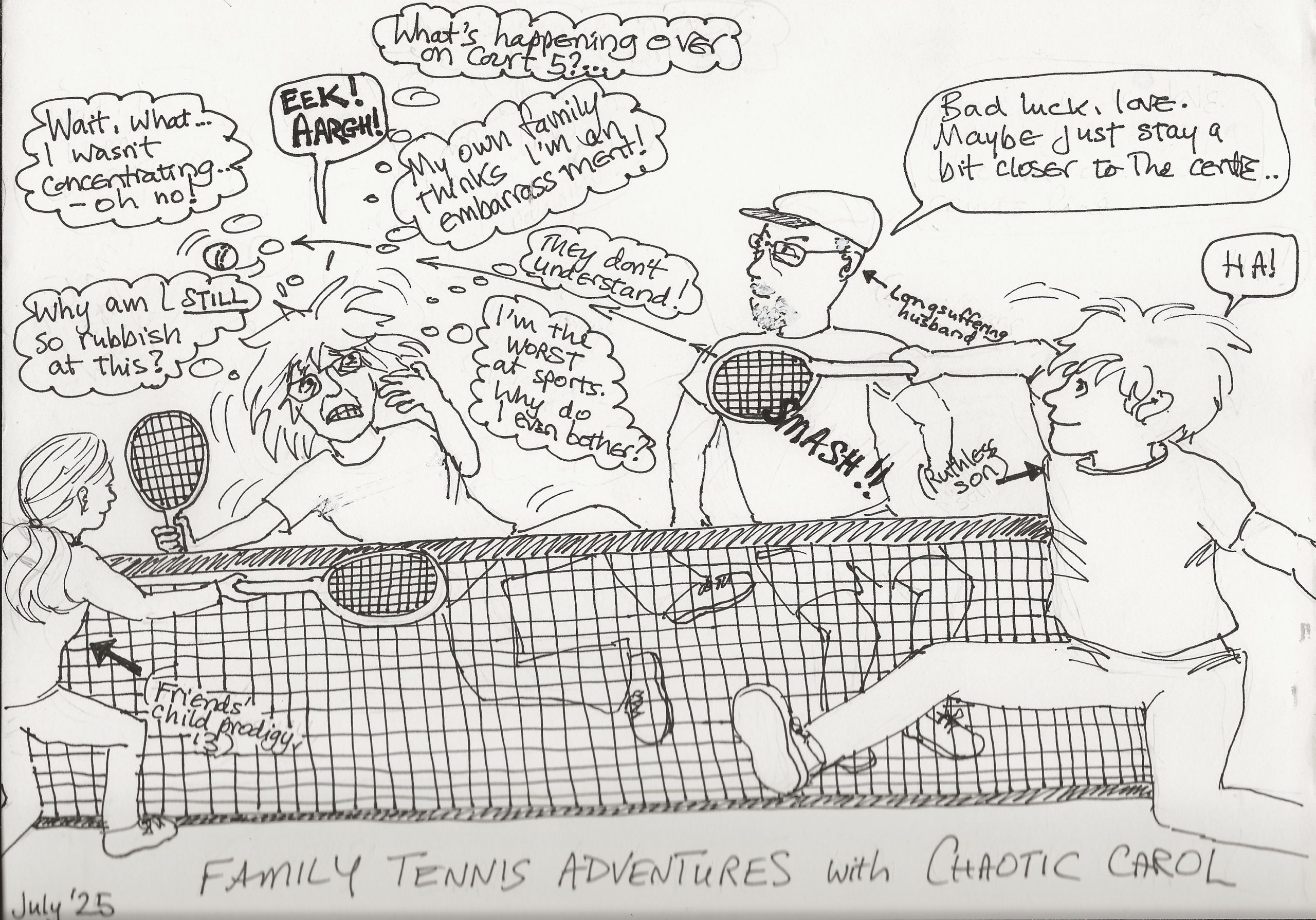
Hi, I’m Carol—an ADHD coach, educator and cartoonist based in North Berwick, near Edinburgh. I love coastal walks, seasonal gatherings and helping adults with ADHD unpick the messiness of life without shame.
If you’re the ADHD adult in your family—or even just wondering—it can feel like an uphill climb. Especially in Scotland, where banter often masks emotion and feelings are something you keep to yourself.
Growing up or living with ADHD here can mean being labelled the scatty one, the drama queen, the one that’s “too much”. Too sensitive. Too chatty. Too distracted. You might still carry those labels into adulthood — while masking and holding a lot together, in reality.
When emotional intensity meets cultural stoicism
At our Healthier Habits peer group this month, we talked about being seen as ‘the problem child’, the emotional load of parenting with ADHD, the challenges of adolescence.
There’s gendered stuff in there (boys being discouraged from showing vulnerability), generational stuff (older family members who pushed feelings down and got on with it), and definitely cultural stuff – consider sport, sectarianism, our religious history, playground cruelty and punishments, alcohol as the needful disinhibitor, bracing ourselves against harsh weather… though there’s plenty good stuff too!
We ADHDers feel things intensely—even if we don’t always have the words at the time. But our bodies know. Many of us were told crying was attention-seeking. Hurt feelings got laughed off. Vulnerability was mocked. And if you’re already rejection-sensitive, this mix of teasing and silence can leave you always on edge, scanning for the next knock.
It doesn’t have to stay that way. In our groups, you can be honest, panicked, proud, messy—all of it—and be met with warmth and good humour.
If you can’t access that kind of support just now, small mental images can help. I like to imagine a vintage hula hoop round myself—keeping others’ words on the outside. Or picture a figure of eight, with me safe in one loop, and their drama in the other.
When everyone’s neurodivergent
If your household includes other neurodivergent folk, it can be vibrant—but noisy and chaotic too. A few things we’ve found helpful:
- Shared routines and calendars
- Code words for needing space or time out
- Weekly check-ins (short and sweet)
- Clear ground rules (like not interrupting)
- Visual prompts to press pause before reacting
- Less screen time at night
- Boundaries with kindness
- Prioritising sleep, food, and movement—for everyone
These are good for any family. For ours, they’re survival tools.
If you’ve felt bullied, misunderstood, endlessly teased or even gaslit in your family—especially before ADHD was spotted—then some ADHD-informed coaching or therapy can be a safe place to unpack all that.
We talk about these things in our coaching groups too. Because trying to work it all out solo, with an ADHD brain, is… challenging.
You’re not alone
In Scotland, we’re brilliant at dry humour, soldiering on, and not making a fuss. But asking for help? Less so.
So here’s your permission slip: you don’t have to figure it all out alone.
At Procrastination Station, we offer down-to-earth courses, coaching, peer groups, friendly meetups and support that actually fits how your brain works.
We laugh a lot. We’re honest. And we celebrate progress, not perfection.
Subscribe here on the home page to stay tuned. Come and meet us, face to face or on Zoom.
You might just find what you didn’t know you were needing.
Carol Stobie
Co-Director, Procrastination Station